
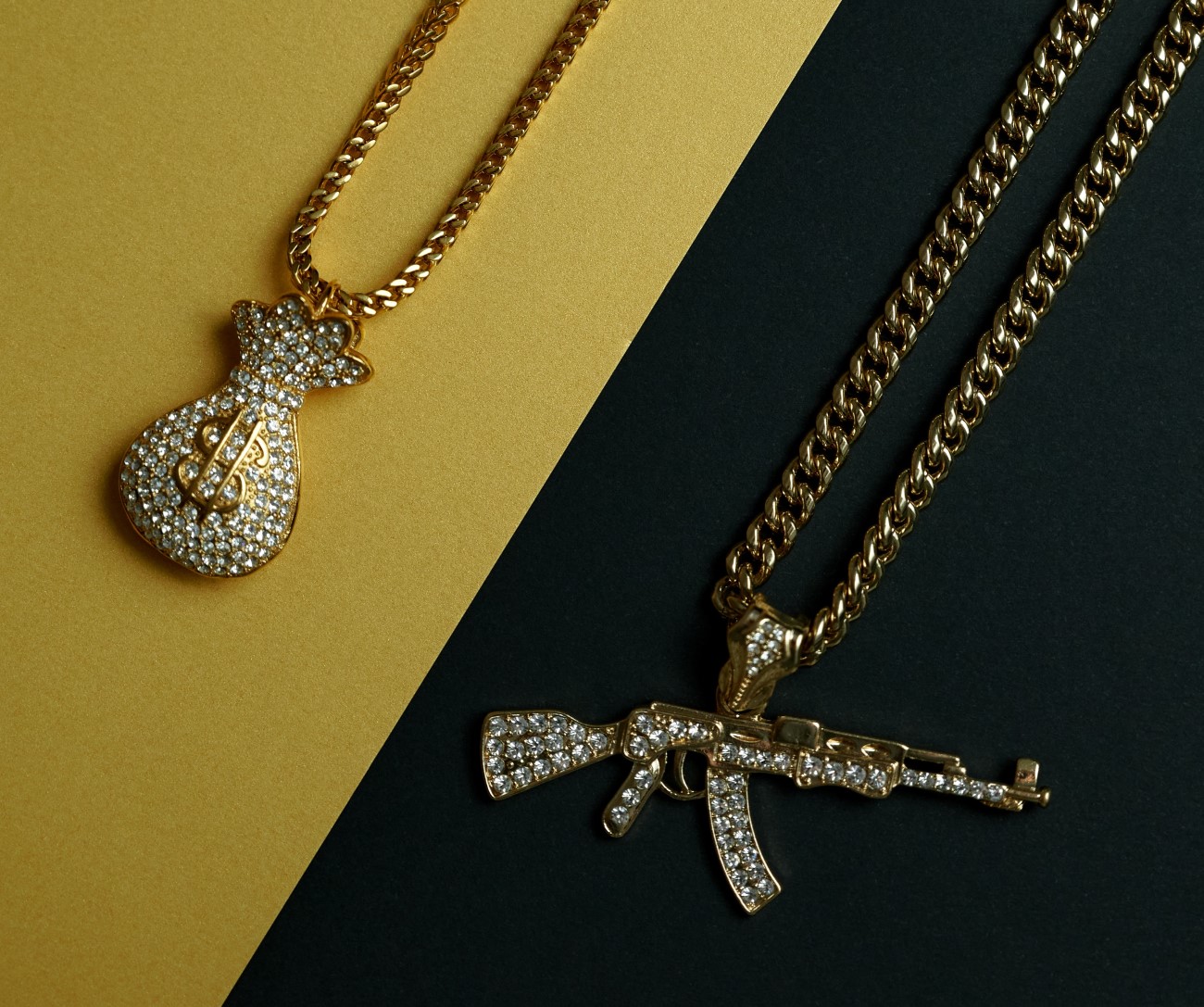
Gold chains are the oldest status symbol still in continuous use. The first ones appeared over 5,000 years ago in Sumer, and they haven’t left our necks since. But the chain you see today — the Miami Cuban link, the rope chain, the Franco — carries a specific history. Each style emerged from a particular culture, time, and technology. This article traces that evolution, naming specific makers and prices along the way.
Where Gold Chains Began: Sumer, Egypt, and the First Links
The earliest known gold chains come from the Royal Tombs of Ur in Mesopotamia (modern-day Iraq), dated to 2500 BCE. Sumerian craftsmen used a technique called loop-in-loop — pulling wire through a drawplate to make thin strands, then linking them by hand. These chains were not mass-produced. A single chain took weeks to make.
Egypt took the craft further. By 1500 BCE, Egyptian goldsmiths were making chains with multiple link patterns: the bead chain, the herringbone, and the snake chain. Tomb paintings show nobles wearing wide gold collars — essentially heavy chains — as markers of divine favor. The gold came from Nubia, which supplied about 50 tons of gold to Egypt over its history. King Tutankhamun’s tomb alone contained over 100 gold chains, many with intricate clasp mechanisms still functional today.
What changed? The Etruscans in Italy (800-300 BCE) invented granulation — fusing tiny gold balls onto chain surfaces. This technique spread through the Roman Empire. Roman soldiers wore gold chains as payment for service, a practice that later evolved into the military “dog tag” chain. By 100 CE, chain-making had become a specialized trade with guilds in Rome, Antioch, and Alexandria.
Key Takeaway for Today
The loop-in-loop technique from Sumer is still used by high-end Italian chain makers like Roberto Coin and Pomellato. If you buy a handmade chain from a Florentine workshop, you’re wearing a 4,500-year-old technology.
The Three Great Chain Revolutions: Technology Changed Everything
Gold chain history breaks into three technological eras. Each one made chains cheaper, more consistent, or more elaborate.
Era 1: Handmade (2500 BCE – 1800 CE). Every link was cut, bent, and soldered by hand. A skilled artisan could make about 10 inches of fine chain per day. Chains were expensive — the equivalent of a year’s wages for a farmer. Only royalty and clergy owned them. The Byzantine chain (a flat, woven pattern) became the signature style of the Eastern Roman Empire from 400 to 1453 CE.
Era 2: Machine-Made (1800 – 1960). The Industrial Revolution brought chain-making machines. In 1810, French inventor Jean-Baptiste LeBlanc patented a machine that could produce 100 feet of chain per day. Prices dropped. Gold chains went from elite-only to middle-class accessories. The rope chain — a twisted, braided style — became the first machine-made chain that looked handmade. By 1900, major manufacturers like Krementz & Co. (founded 1866 in Newark, New Jersey) were producing chains for department stores.
Era 3: Laser-Welded (1960 – present). Laser welding eliminated the need for solder. This allowed for thinner, more intricate links that wouldn’t break at the joints. The Miami Cuban link — a thick, interlocking oval chain — became possible only with laser precision. Italian factories in Vicenza and Arezzo, like Fope and Gianni Carità, led this revolution. A modern laser-welded chain can have over 1,000 links and weigh under 5 grams, something impossible before 1960.
| Era | Production Rate | Cost (adjusted to 2026 dollars) | Typical Buyer |
|---|---|---|---|
| Handmade (2500 BCE) | 10 inches per day | $5,000 – $20,000 per chain | Royalty, priests |
| Machine-Made (1850) | 100 feet per day | $200 – $800 per chain | Middle class, merchants |
| Laser-Welded (2026) | 500 feet per day | $50 – $5,000 per chain | Everyone |
How Gold Chains Became a Global Status Symbol
Gold chains didn’t just sit in Europe. Three cultures independently developed their own chain traditions, each with a distinct aesthetic.
West Africa. The Akan people of Ghana (1200 CE onward) created gold dust chains — delicate, hand-woven strands used to hold gold dust used as currency. These chains were both money and jewelry. The Ashanti king wore a gold chain weighing over 20 pounds during ceremonies. Today, African gold chain styles influence modern designs from Vita Fede and Lagos.
Mesoamerica. The Mixtec and Zapotec of Oaxaca, Mexico (900-1520 CE) were the most skilled goldsmiths in the Americas. They used the lost-wax casting method to create chains with animal-head clasps and hollow links. Monte Albán tombs contain gold chains with bells attached — they jingled when the wearer moved. Spanish conquistadors melted most of this gold, but about 200 pre-Columbian gold chains survive in museums today.
India. India has the oldest continuous gold chain tradition outside the Middle East. The Mughal Empire (1526-1857) produced chains with enamel work and gemstone settings. The Kundan chain — where gold foil is set with uncut diamonds — remains a wedding staple. Modern Indian brands like Tanishq and Kalyan Jewellers sell chains that combine Mughal patterns with Italian manufacturing. A typical 22-karat Indian gold chain (22K is standard there, vs 14K in the US) costs about $2,000-$5,000 for a 20-inch piece.
Gold Chains in America: From Puritan Plainness to Hip-Hop Bling
America’s relationship with gold chains is a story of rebellion. Early Puritan settlers banned jewelry altogether. Gold chains didn’t reappear in mainstream American fashion until the 1850s, when Tiffany & Co. (founded 1837) started selling gold watch chains. These were functional — men attached pocket watches to them — but also status markers. A Tiffany gold curb chain from 1865 sold for $350 (about $12,000 today).
The real shift happened in the 1970s and 1980s. Two forces changed everything:
- Italian manufacturing goes global. Factories in Vicenza, Italy, started exporting machine-made chains to the US at prices 60% lower than American-made. The Miami Cuban link became the defining chain of the era — thick, heavy, and flashy. A 14K Miami Cuban from Jacmel Jewelry (a key distributor) cost about $500 for a 20-inch chain in 1985.
- Hip-hop culture adopts the chain. Kurtis Blow wore a gold chain on the cover of his 1980 album. Run-D.M.C. made thick gold chains their uniform. By 1990, a gold chain was the single most recognizable symbol of hip-hop success. Jacob the Jeweler (Jacob Arabo) started making custom pieces for rappers in the 1990s, including the first “iced-out” chains — chains fully covered in diamonds. His Jacob & Co. brand now sells chains starting at $15,000.
Today, the gold chain market in the US is worth $4.5 billion annually. The most popular styles are the Miami Cuban, the Franco (a V-shaped link), and the rope chain. Cartier sells their classic Love chain in 18K gold for $2,650. David Yurman cable chains start at $850. Macy’s sells mass-market 14K chains for $150-$500.
What Your Gold Chain Says About You (Whether You Like It or Not)
Chain styles carry cultural weight. Here’s the honest breakdown of what each style communicates:
Miami Cuban link. Thick, bold, interlocking ovals. This chain says “I’m confident and I want you to know it.” It’s the chain of hip-hop, of Miami nightlife, of the 1980s cocaine era. A 10mm wide Cuban link in 14K gold from Mens Chains Online costs about $1,200 for 20 inches. If you wear this, people assume you’re extroverted and maybe a little flashy.
Rope chain. Twisted, braided, catches light. This is the most versatile chain — works with pendants or alone. It says “I appreciate classic design but don’t need to shout.” A 3mm rope chain from Kay Jewelers in 14K costs $400. It’s the default choice for first-time gold chain buyers.
Franco chain. Flat, V-shaped links. It says “I know details matter.” The Franco is less common than Cuban or rope, so wearing one signals connoisseurship. Jewelry by Johan sells a handcrafted 14K Franco for $1,800. Architects and designers tend to prefer this style.
Figaro chain. Alternating short and long links. This is the classic Italian chain — three short links, one long, repeated. It says “I have taste but I’m not trying too hard.” Michael Hill sells a 14K Figaro for $350. It’s the chain you wear to a business dinner, not a club.
Box chain. Square links that lie flat. This is the utilitarian chain — strong, simple, often used for pendants. It says “I bought this for function.” A 14K box chain from Zales costs $250. It’s the least expressive style, which is exactly why some people choose it.
What NOT to wear. Avoid buying a gold-plated chain (gold over brass or steel) if you want it to last more than a year. The gold wears off at friction points — the clasp, the back of the neck. A 14K solid gold chain from a reputable seller like James Allen or Blue Nile will outlive you. A plated chain from a mall kiosk will leave green marks on your skin within six months.
How to Buy a Gold Chain in 2026 Without Getting Ripped Off
The gold chain market is full of traps. Here’s what matters most.
Karat weight is not purity in the way you think. 24K gold is pure gold — but it’s too soft for a chain. It bends and scratches easily. 14K gold (58% gold, 42% alloy) is the standard for durability in the US. 18K (75% gold) is softer but richer in color. Never buy a daily-wear chain in 24K — it will break within a year. Cartier uses 18K for their chains. Tiffany & Co. uses 18K and 14K. Most Italian chains are 14K.
Weight matters more than length. A 20-inch chain that weighs 5 grams is thin and delicate. A 20-inch chain that weighs 30 grams is substantial. Price scales with weight. In 2026, gold is trading at about $2,600 per ounce. A 14K chain (58% gold) costs roughly $50 per gram in raw gold value, plus markup. If a seller offers a 20-inch 14K chain for $200, it weighs about 4 grams — very thin. A 30-gram chain costs about $1,500. Know the gram weight before you buy.
Clasp type is critical. The clasp is the weakest point. Lobster clasps are the most secure. Spring ring clasps (the round ones) fail over time. A good chain from Jewelry by Johan or Jacmel uses a lobster clasp with a soldered jump ring. Cheap chains use a stamped spring ring that will bend open.
Buy from a seller who publishes weight and width. If a listing says “14K Gold Chain” but doesn’t list gram weight or link width in millimeters, skip it. Reputable sellers: James Allen (online, transparent specs), Blue Nile (good return policy), Mens Chains Online (specializes in heavy chains). Avoid Etsy sellers with no reviews and prices that seem too good — they’re selling hollow chains that dent easily.
The single most important takeaway: A gold chain is a 5,000-year-old technology that still works because it solves a human need — to carry value and identity visibly on your body — and the best chain you can buy is a solid 14K or 18K piece from a seller who lists the gram weight, because that number tells you exactly what you’re getting.