I watched a friend spend $3,200 on a diamond tennis bracelet that she never wore. The clasp broke after three months, the diamonds looked dull under her office lights, and the 7-inch length slid halfway up her forearm. She bought the wrong one because she didn’t know what to look for. That mistake cost her time, money, and the joy of wearing jewelry she loved.
This guide fixes that. You’ll learn exactly how to pick a tennis bracelet that fits, sparkles, and stays secure — without overpaying or getting tricked by marketing fluff.
What Makes a Tennis Bracelet Different From Any Other Bracelet
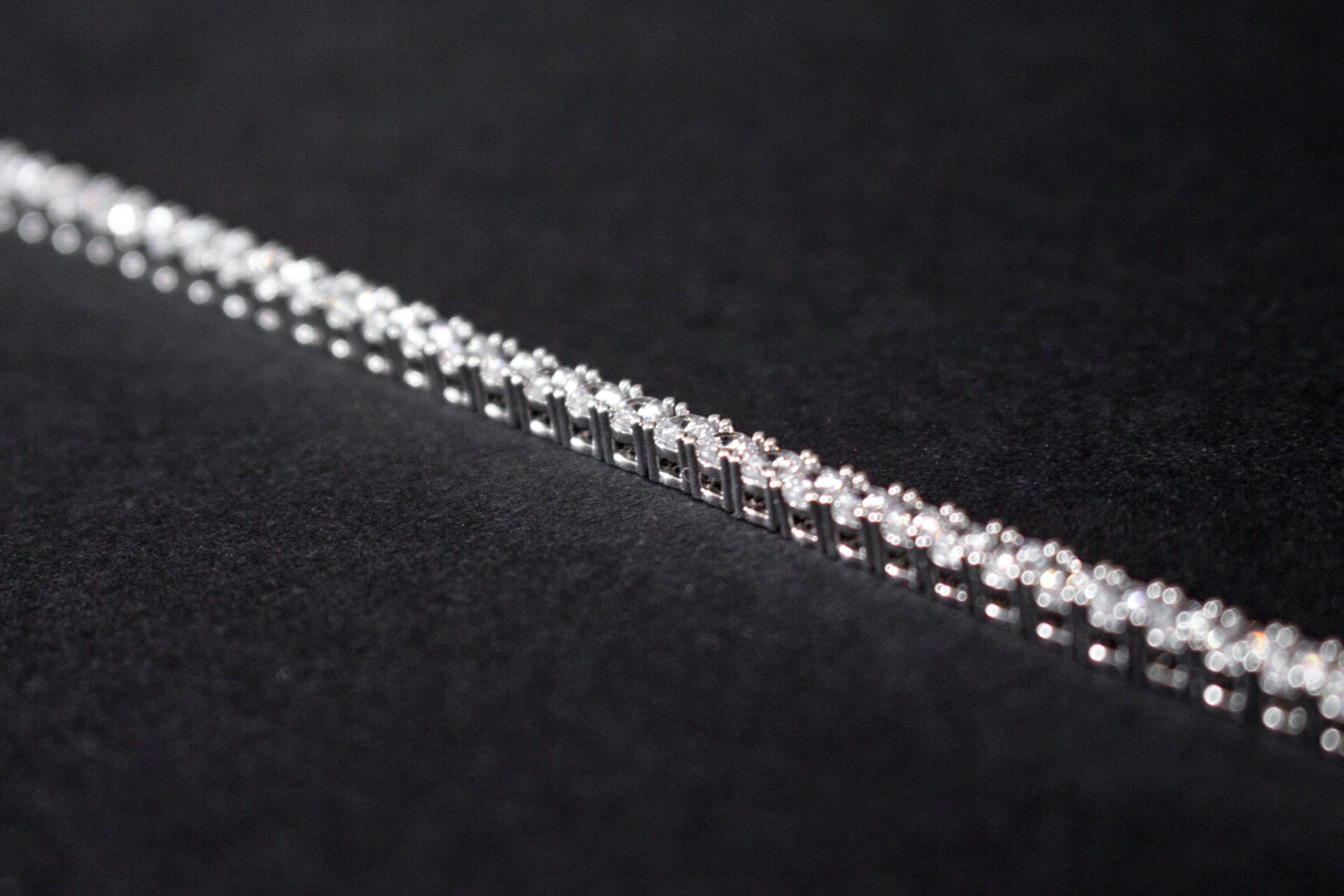
A tennis bracelet is a single row of identically cut diamonds (or gemstones) set in a flexible line of metal. Each stone sits in its own individual setting, connected by hinges or links that let the bracelet drape flat against your wrist.
The name comes from Chris Evert. She wore one during a 1987 US Open match, the clasp broke, and she asked the umpire to stop the game so she could find her diamonds on the court. That story stuck. Today, the design is defined by three non-negotiable features:
- Continuous line of stones — no gaps, no decorative metal bars between diamonds
- Flexible construction — the bracelet bends and moves with your wrist
- Secure clasp — usually a box clasp with a safety latch, because losing a single diamond costs hundreds to replace
The fundamental problem a tennis bracelet solves is simple: you want maximum sparkle with minimum bulk. Unlike a bangle that clacks against your desk or a chain bracelet that twists, a tennis bracelet lies flat and catches light from every angle. That’s why it works equally well with a t-shirt and jeans or a formal gown.
But that simplicity hides complexity. The quality of the diamonds, the metal, and the clasp engineering varies wildly between a $500 bracelet and a $10,000 one. Most buyers don’t know which differences matter and which are just marketing.
How Diamond Quality Actually Affects the Look (and the Price)
Diamond quality is measured by the 4Cs: cut, color, clarity, and carat weight. For tennis bracelets, the order of importance flips compared to engagement rings.
Cut is everything
In a tennis bracelet, cut matters more than any other factor. A well-cut diamond reflects light back to your eye. A poorly cut one looks flat and dark, even if it’s color D and internally flawless.
Look for diamonds graded Excellent or Very Good by GIA or AGS. Avoid Good or Fair cuts. The difference is visible. A round brilliant diamond with Excellent cut reflects 95-98% of incoming light. A Good cut reflects around 70%. In a line of 40 diamonds, that difference compounds into a bracelet that looks dead instead of alive.
Color is negotiable
Diamond color for tennis bracelets is graded D (colorless) to Z (light yellow). Here’s the truth: unless you’re buying platinum or white gold, you can go lower than you think.
Set in yellow gold, diamonds graded G-H-I look white. The warm metal masks any slight yellow tint. Set in rose gold, you can go down to J-K without seeing color. Only in platinum or white gold should you aim for D-E-F.
This is where you save money. Dropping from D to G color drops the price roughly 20-30% with zero visible difference in a yellow gold setting.
Clarity is easy
For a tennis bracelet, VS2 or SI1 clarity is the sweet spot. Inclusions visible under 10x magnification are invisible to the naked eye when the diamond is set and moving on your wrist. You don’t need VVS or IF. That’s wasted money.
The one exception: avoid diamonds with black inclusions or feathers near the girdle edge. Those can chip during wear.
Carat total weight (CTW) determines presence
A tennis bracelet’s total carat weight ranges from 2 carats (delicate, understated) to 10+ carats (bold, statement). The most popular range for daily wear is 3-5 carats total. That gives visible sparkle without looking flashy.
Each individual diamond in a 4-carat bracelet is roughly 0.10 carats (10 points). At that size, the cut quality dominates the visual impact far more than the exact carat weight.
| Carat Total Weight | Individual Stone Size | Best For | Typical Price Range |
|---|---|---|---|
| 2-3 CTW | 0.05-0.07 ct | Daily wear, small wrists | $800-$2,500 |
| 4-5 CTW | 0.10-0.12 ct | Versatile, most popular | $2,000-$5,000 |
| 6-8 CTW | 0.15-0.20 ct | Statement piece, special occasions | $4,500-$10,000 |
| 10+ CTW | 0.25+ ct | High-end, investment | $10,000+ |
Prices above are for G-H color, VS2 clarity, Excellent cut diamonds set in 14k gold. Adjust up 40% for platinum, down 20% for silver.
Metal Choice: Gold, Platinum, or Silver
The metal determines durability, skin compatibility, and how the diamonds read visually. This is not a cosmetic choice — it affects how long the bracelet lasts.
14k gold is the standard for a reason. It’s hard enough to hold diamonds securely without bending. 18k gold is softer and prongs can loosen over time. 10k gold is harder but looks slightly paler. For most people, 14k yellow or white gold is the best balance of durability and color.
Platinum is denser and stronger than gold. It holds diamonds more securely and develops a soft patina over time. It costs roughly 50% more than 14k gold. If you have metal allergies or want the most secure setting, platinum wins. The Cartier Love bracelet in platinum costs around $7,000 for a plain version, while a diamond tennis bracelet in platinum from Blue Nile starts at $3,500 for 3 CTW.
Sterling silver works at lower price points but has real downsides. Silver tarnishes. It’s soft, so prongs can bend and lose diamonds. And silver’s bright white color can make lower-color diamonds look yellow by contrast. If your budget is under $1,000, silver is acceptable, but expect to replace the bracelet in 3-5 years. The James Allen silver tennis bracelet with 2 CTW costs $650 — a solid entry point.
Rose gold is trendy but scratches more visibly than yellow or white gold. The copper content makes it harder than yellow gold, but the surface shows wear patterns faster. If you choose rose gold, accept that it will need re-polishing every 2-3 years.
My pick: 14k white gold for versatility. It matches everything, doesn’t tarnish, and makes G-H color diamonds look bright white. If your budget allows, platinum for the security.
The Clasp Is the Most Important Mechanical Part
Every tennis bracelet failure I’ve seen — including my friend’s $3,200 mistake — started with the clasp. A broken clasp means lost diamonds. Period.
The standard is a box clasp with a double safety latch. The box clasp has a tongue that slides into a receiver. Two spring-loaded buttons release it. The safety latch is a separate hook that clips over the clasp as backup.
Here’s what to check before buying:
- Test the tension. The clasp should click into place with a firm, audible snap. Loose clasps open accidentally.
- Check the safety latch. It should require deliberate finger pressure to open. If it flips open easily, reject the bracelet.
- Look at the hinge. The clasp hinge should be solid metal, not stamped thin sheet metal. Stamped hinges bend and fail within months.
Brands like Tiffany & Co. use a proprietary clasp system on their Return to Tiffany tennis bracelet ($4,500 for 3 CTW) that has a hidden safety catch. Cartier uses a double-deployment clasp on their diamond bracelets. Both are excellent. At lower price points, check that the clasp is made by the same jeweler, not a generic mass-produced clasp that doesn’t fit the bracelet’s curve.
One test: close the clasp, hold the bracelet by the clasp end, and shake it gently. If it rattles or feels loose, move on.
Common Mistakes That Cost You Money or Diamonds
I’ve seen these three mistakes ruin perfectly good purchases.
Mistake 1: Buying by carat weight alone. A 5-carat bracelet with poorly cut, included diamonds looks worse than a 3-carat bracelet with excellent cut, VS2 diamonds. The sparkle comes from cut, not carats. Always prioritize cut over size.
Mistake 2: Ignoring the setting type. There are two main settings: prong and bezel. Prong settings (four or six tiny metal claws holding each diamond) let more light through the stone, making it sparkle more. But prongs can snag on clothing and require periodic tightening. Bezel settings (a metal rim around each diamond) are more secure and snag-proof, but they block light and reduce sparkle by about 15%. For daily wear, bezel is safer. For maximum shine, prong.
Mistake 3: Not checking the return policy and warranty. A tennis bracelet is a precision mechanical object. Diamonds can loosen. Clasps can fail. Buy from a seller with at least a 30-day return policy and a 1-year warranty on workmanship. Blue Nile offers a 30-day return and a 1-year warranty. James Allen offers the same. Local jewelers often offer lifetime cleaning and tightening — that’s worth paying a small premium for.
When a Tennis Bracelet Is the Wrong Choice
A tennis bracelet is not for everyone. Here’s when you should buy something else.
If you work with your hands. Mechanics, nurses, chefs, and anyone who bangs their wrists against hard surfaces should skip a tennis bracelet. The diamonds can chip, and the prongs can catch on gloves or equipment. A leather wrap bracelet or a silicone band is smarter.
If you want something you never take off. Tennis bracelets need removal for sleeping, showering, and heavy cleaning. The clasp can open in sleep. Soap dulls the diamonds. If you want a permanent bracelet, get a welded chain bracelet like the one from Catbird (around $300) or a solid bangle.
If your budget is under $500. At that price, the diamonds are low quality (I-J color, SI2 clarity, Good cut) and the metal is silver or gold-plated. The clasp will likely fail. Save up to $800 minimum for a bracelet that lasts. The Mejuri diamond tennis bracelet ($480) is the cheapest I’d recommend, and even that uses smaller stones (0.03 ct each) and a thinner clasp.
If you prefer color. A tennis bracelet is defined by white diamonds. If you want color, look at gemstone tennis bracelets — sapphire, ruby, or emerald. They cost less per carat and offer more personality. A sapphire tennis bracelet from Jared costs around $1,200 for 3 CTW.
How to Verify You’re Getting What You Pay For
Before you hand over your credit card, do these three things.
Ask for the GIA or AGS grading report. Not a generic certificate from the jeweler. GIA and AGS are independent labs. If the seller can’t provide one, they’re hiding something. For tennis bracelets, the report should cover the total carat weight, the color and clarity range of the diamonds, and the cut grade.
Check the diamond count. A standard 7-inch tennis bracelet has 40-50 diamonds. Count them. If the bracelet has significantly fewer diamonds for the same total carat weight, the individual stones are larger, which means they’re set farther apart. That reduces the continuous sparkle effect. A 4-carat bracelet with 30 diamonds looks gappy. One with 45 diamonds looks solid.
Test the flexibility. The bracelet should bend 180 degrees without resistance. If it’s stiff, the hinges are poorly made and will wear unevenly. Bend it in your hand. It should feel like a fabric ribbon, not a wire.
Weigh it on a scale. The total weight of the bracelet (metal + diamonds) should match the seller’s specification. A 4-carat diamond tennis bracelet in 14k gold should weigh roughly 8-10 grams. If it’s lighter, the metal is thinner than standard, which means it will bend and break faster.
The Tiffany & Co. diamond tennis bracelet (3 CTW, platinum) weighs 11.2 grams. The Blue Nile version (3 CTW, 14k white gold) weighs 8.5 grams. Both are well-made, but the Tiffany uses thicker metal. That extra weight costs $2,000 more.
A tennis bracelet is a precision purchase. The right one lasts decades, works with every outfit, and never goes out of style. The wrong one sits in a drawer. Now you know the difference.