Most people assume a bathroom renovation in Glasgow is the same as one in London or Manchester. That assumption costs them thousands. Scottish Building Standards differ from English regs. Your tenement flat has plumbing from the 1960s. And a wetroom that works in a modern new-build will flood your Victorian sandstone conversion.
This is not legal advice — consult a licensed contractor or architect for your specific property. But here are the eight mistakes I see most often in Glasgow bathroom projects, based on conversations with local tradespeople and homeowners who learned the hard way.
Mistake 1: Ignoring the Tenement Factor
Glasgow has more tenement flats than any other UK city. These buildings (built 1870–1910) have shared plumbing stacks, cast-iron waste pipes, and no cavity walls. Your renovation affects your downstairs neighbour.
Scottish Building Standards require you to notify neighbours of any work that affects shared services. You also need a Building Warrant for structural changes — moving a toilet or sink more than 300mm from its existing position triggers this.
Most homeowners skip the warrant to save £300. Then the neighbour’s ceiling collapses, and you’re liable for £4,000 in repairs plus legal fees.
What to do instead
Before you book a contractor, check your title deeds. Many Glasgow tenements have “common property” clauses — you don’t own the waste pipe running through your floor; you share it with the flat below. Any work on shared pipes needs written permission from the factor or owners’ association.
Get a Building Warrant application submitted before you buy tiles or fixtures. The Glasgow City Council planning portal lists approved inspectors. Budget £350–£600 for the warrant, plus £150 for a structural engineer report if you’re moving plumbing.
Mistake 2: Choosing the Wrong Tiler (And the Wrong Tile)
Glasgow’s climate is damp. Your bathroom will see condensation, steam, and occasional leaks. The wrong tile choice leads to mould behind the grout within 18 months.
Porcelain tiles with a PEI rating of 4 or 5 are the only sensible choice for bathroom floors. Ceramic tiles absorb water — they’re fine for walls, but not floors. Natural stone (slate, marble) needs annual sealing in Glasgow’s soft water area. Most homeowners skip this, and the stone stains.
Local tilers in Glasgow charge £35–£55 per square metre for fitting. A cheap tiler at £25/m² will use rapid-set adhesive that fails in wet conditions. You get what you pay for.
The tiler checklist
- Ask for three recent Glasgow bathroom projects with photos
- Check they use cement-based flexible adhesive (not ready-mix) in wet areas
- Confirm they leave a 2–3mm expansion gap at walls — tenement buildings move seasonally
- Get a written guarantee for waterproofing in the shower area
Mistake 3: Underestimating the Plumbing Work
Here’s the hard truth: most Glasgow bathrooms built before 1990 have copper pipes with lead solder joints, galvanised steel supply lines, and cast-iron waste stacks. Your new thermostatic shower valve won’t connect to a 22mm copper pipe with a compression fitting — it needs a different thread.
A full plumbing re-pipe in a tenement bathroom costs £1,200–£2,500. That’s not optional — it’s mandatory if you’re moving fixtures more than 1 metre from the original location.
Victoria Plum and Bathstore sell shower valves that claim “universal fit.” They don’t account for Glasgow’s 3-bar mains pressure (low compared to London’s 5-bar). You need a shower pump or a mains-pressure-compatible valve. Check the product spec for “minimum operating pressure 1.5 bar” — if it says 2.5 bar, it won’t work in your flat.
When to call a specialist
If your tenement has a shared hot water cylinder (common in pre-1960 builds), you cannot change the pipework without a plumber registered with the Scottish Building Standards. Do not let a general contractor touch the hot water system — it’s a criminal offence if done without certification.
Mistake 4: Skipping the Ventilation Upgrade
Glasgow has 170 rainy days per year. Your bathroom generates litres of moisture every shower. The original 1970s extractor fan (if it still works) moves 15 litres of air per second. You need 30 litres per second minimum for a standard bathroom, 45 litres for a wetroom.
Most homeowners buy a cheap fan from Wickes for £40. It’s loud (45dB), inefficient, and fails within two years. A proper in-line fan mounted in the loft (with a ceiling grille) costs £180–£300 but runs at 25dB and moves 40 litres per second.
Vent-Axia and Manrose make models suitable for Glasgow’s humid climate. Look for a fan with a humidity sensor — it activates automatically when steam rises, which prevents mould better than a timer switch.
The cost of bad ventilation
Mould remediation in a Glasgow bathroom costs £500–£1,500. New plasterboard and paint: another £800. A proper fan costs £250 installed. The math is simple.
Mistake 5: Buying Fixtures Without Measuring the Space
Standard UK bathroom fixtures assume a room at least 2.4m x 1.8m. Glasgow tenement bathrooms are often 1.8m x 1.5m — sometimes smaller. A standard 1700mm bath won’t fit. A 600mm vanity unit leaves you 700mm of walking space (too tight).
I’ve seen homeowners buy a Bathstore Monaco basin cabinet (600mm wide) for a 1.5m-wide room. It fit, but the toilet was then 50mm from the wall — you couldn’t sit on it without your knees touching the door.
Measure these three things
- Door swing clearance — can the door open fully without hitting the toilet or vanity?
- Toilet rough-in — distance from the finished wall to the centre of the soil pipe. Standard UK is 300mm. Glasgow tenements often have 400mm or 500mm rough-ins. Buy a toilet that matches.
- Shower tray depth — low-profile trays (40mm) look modern but need a 50mm waste trap that may not fit under a suspended timber floor. You might need a 90mm tray instead.
Mistake 6: Ignoring the Wetroom Regulations
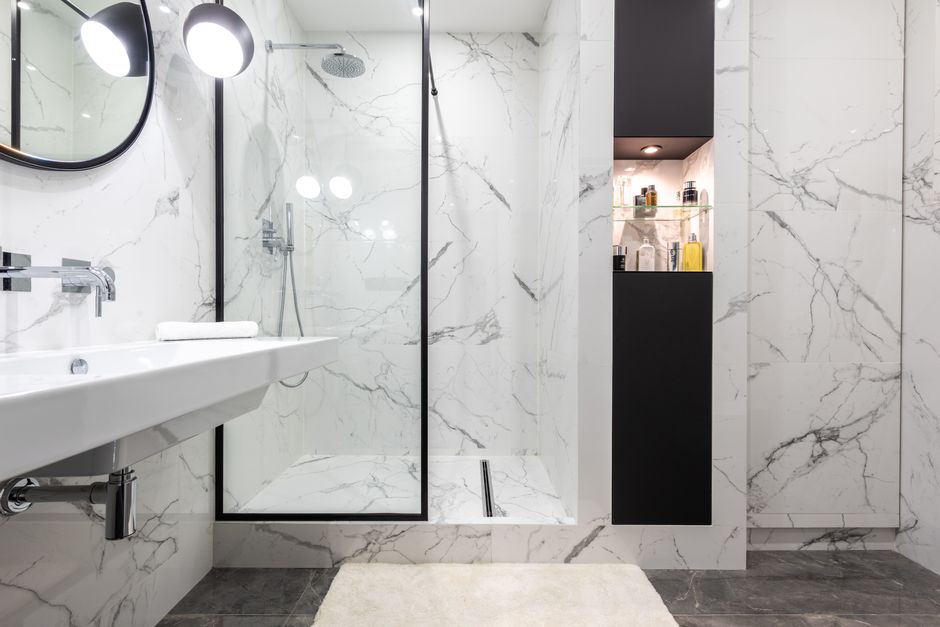
Wetrooms are popular in Glasgow because they make small bathrooms feel bigger. But Scottish Building Standards Section 3.4 requires a wetroom to have a fall (slope) of at least 1:80 towards the drain, a tanked waterproof membrane, and a drain that meets BS EN 1253.
Most DIY wetroom kits sold at Wickes and B&Q include a foam former with a pre-formed fall. That’s fine for a concrete floor. Glasgow tenements have timber joist floors — the foam former can crack when the floor moves.
You need a wetroom former with a plywood or cement board base (not just foam). Brands like Impey and Schlüter make these. Cost: £250–£450 for the former, plus £150 for the membrane kit. Do not skip the membrane — water will find the gap.
The real cost of a wetroom
A proper wetroom installation in a Glasgow tenement costs £3,500–£5,500. That includes:
- Floor strengthening (joist sistering or plywood overlay): £400
- Wetroom former and membrane: £400
- Tanking the walls (liquid membrane): £300
- Tiling with porcelain: £800–£1,200
- Drain and pipework: £300
If a contractor quotes £2,000 for a wetroom, they’re not doing the floor strengthening or the tanking. Walk away.
Mistake 7: Not Planning for the Waste Removal
Glasgow City Council charges £35 per tonne for waste disposal at the Blochairn or Polmadie recycling centres. A full bathroom renovation produces 1.5–2.5 tonnes of debris — old tiles, plasterboard, bath, toilet, sink. That’s £70–£90 in skip hire.
But here’s the catch: you cannot put asbestos-containing materials in a standard skip. Many Glasgow bathrooms built before 1985 have asbestos in the floor tiles, ceiling artex, or pipe lagging. If you remove it yourself, you’re breaking the law.
A licensed asbestos removal company charges £400–£800 for a bathroom-sized job. Most homeowners don’t budget for this. Then they find artex on the ceiling, the skip company refuses to take it, and the project stops for two weeks.
What to budget for waste
| Item | Cost (Glasgow, 2026) |
|---|---|
| Skip hire (4-yard, 7 days) | £180–£250 |
| Asbestos testing (1 sample) | £50–£80 |
| Asbestos removal (bathroom) | £400–£800 |
| Council tip fees (non-skip) | £35/tonne |
Total waste budget: £630–£1,130. Plan for it before you start.
Mistake 8: Choosing the Wrong Contractor (The Cheap Quote Trap)
I spoke to a homeowner in Shawlands who got three quotes for a full bathroom renovation. One was £4,500, one was £7,200, and one was £11,000. She chose the £4,500 quote. The contractor didn’t pull a Building Warrant, used non-waterproof adhesive in the shower, and left a 10mm gap between the bath and the wall. The job cost £6,200 to fix — more than the middle quote.
A realistic budget for a full bathroom renovation in Glasgow (medium spec, 2.4m x 1.8m room) is £7,000–£10,500. That includes:
- Plumbing (full re-pipe): £1,500
- Tiling: £1,200
- Fixtures (toilet, sink, bath, shower): £1,500–£2,500
- Labour: £2,500–£3,500
- Waste and permits: £800
If a quote comes in under £5,500 for a full renovation, ask why. The answer is usually “I’m not doing the paperwork” or “I’ll use cheap materials.” Neither ends well.
How to vet a Glasgow contractor
Check three things:
- Scottish Building Standards registration — ask for their SER (Scottish Energy Register) number for gas work, and their Approved Certifier status for building warrants
- Insurance — public liability of at least £2 million, plus employer’s liability if they have staff
- References — ask for three Glasgow clients from the last 12 months, not the last 5 years
If they can’t provide all three, move on. There are enough good contractors in Glasgow that you don’t need to take a risk.
The best bathroom renovations in this city are the ones where the homeowner understood the building, the regulations, and the real cost before anyone picked up a hammer. That knowledge saves you money, stress, and a call to your neighbour to apologise about the water stain on their ceiling.