Small tears in cushion covers and curtains rarely need a full sewing project. The right stitch, matching thread, and a few minutes of careful preparation can restore a split seam without making the repair more visible than the damage.
Which quick stitch fixes cushion and curtain damage best?
The best stitch depends on where the fabric failed. A cushion cover usually tears along a seam because repeated sitting pulls the seam allowance apart. A curtain more often suffers from a loose hem, a pulled fold, or a small tear near a heading tape. Those areas need different repairs.
Use a ladder stitch for opened seams
Choose a ladder stitch when the fabric edges still meet cleanly. Turn the cover inside out, fold the raw edges inward by about 6 mm, and make small horizontal stitches from one folded edge to the other. Pull the thread gently after every two or three stitches. The edges should close without puckering. This stitch works well on cushion covers, pillow covers, and curtain hems where you want the repair to disappear.
Use a backstitch for short tears under strain
Choose a backstitch when the tear sits in a high-tension area. Insert the needle about 3 mm ahead of the starting point, bring it up, then take the needle back into the end of the previous stitch. The overlapping thread path creates a firm line that handles pulling better than a running stitch. Keep each stitch between 2 mm and 3 mm on medium-weight cotton or linen.
Use a whipstitch only on hidden edges
A whipstitch closes raw edges quickly, but its diagonal thread lines can show on the front. It suits the inside edge of a lining, the back of a curtain heading, or a cushion seam hidden by piping. For visible fabric, ladder stitch gives a cleaner finish. The clear winner for a neat cushion repair is ladder stitch; the clear winner for a stressed tear is short backstitch.
How should you prepare fabric before sewing a fast repair?
Three minutes of preparation prevents most failed mends. Skipping this stage often creates a repair that looks tight at first and then puckers after washing or hanging.
Follow this five-step preparation check
- Remove the cover from the cushion if possible. For curtains, support the fabric on a clean table instead of sewing while the panel hangs.
- Trim only loose threads. Do not cut into stable fabric to make the tear look neat.
- Press the area on the correct heat setting for the fiber. Test an unseen corner first, especially with velvet, synthetics, or coated blackout fabric.
- Match the grain line by laying the fabric flat and aligning nearby threads. A repair across a distorted grain can pull sideways.
- Pin or clip the edges so they meet naturally. Do not force a stretched edge to match a shorter one.
Mark the safe sewing zone
Stop the stitch at least 10 mm beyond each end of a tear. That extra length spreads the load and keeps the split from reopening beside the repair. On a seam, work inside the existing seam allowance whenever there is enough fabric. If the edge has frayed more than 6 mm, a small backing patch on the wrong side gives the thread something firm to hold.
Test tension before closing the repair
Make three test stitches on a hidden section. If the fabric gathers, loosen your pull. If the stitches sit in loose loops, shorten the thread or use a smaller needle. The finished fabric should lie flat before the repair leaves your hand.
Which needle and thread choices make a repair hold?
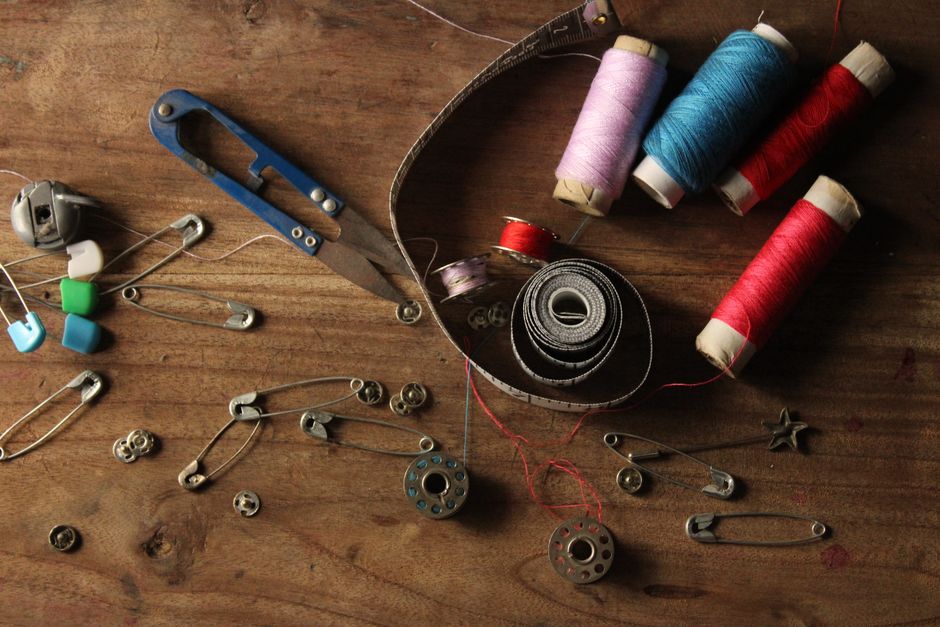
For most home textile repairs, thread weight and needle size matter more than the brand of sewing kit. Polyester thread handles washing and repeated movement better than ordinary cotton thread, while a sharp universal needle enters woven fabric without making oversized holes.
Compare practical repair supplies
| Supply | Useful specification | Best repair | Main warning |
|---|---|---|---|
| Gutermann Sew-All thread | 100% polyester, commonly sold on 100 m spools | Cushion seams and washable curtains | Match color and sheen; a slightly darker shade often disappears better than a bright match |
| Schmetz Universal needle | Size 80/12 for medium cotton or linen | General hand mending and light machine work | Use size 70/10 for delicate fabric and 90/14 for heavy upholstery fabric |
| Clover Wonder Clips | Flat bases marked for 1/4-inch and 1/2-inch positions | Holding thick seams without puncturing fabric | Do not leave clips on folded fabric for long-term storage |
| Singer 4423 sewing machine | 23 built-in stitches and 97 stitch applications | Frequent repairs or long curtain hems | Overkill for one loose seam or a 3 cm tear |
Choose thread for movement, not just color
For a cushion cover that will be washed, 100% polyester thread is the safest general pick. Silk thread creates a fine finish but costs more and suits delicate decorative work. Heavy upholstery thread can look bulky on cotton and may cut into weakened fabric when pulled tight.
Choose the smallest needle that does the job
A needle that is too large leaves visible holes beside the mend. A needle that is too small bends or makes you pull hard. For ordinary curtain cotton, size 70/10 or 80/12 is a sound starting point. For thick canvas cushion covers, move to 90/14 and use shorter stitches.
Should you hand-sew or machine-sew a curtain and cushion repair?
Hand sewing is the better choice for most small visible repairs. It gives you control around corners, piping, lining, and uneven fabric. A machine wins only when the damaged area is long, straight, and easy to access.
When is hand sewing the right answer?
Use hand sewing for a split under 10 cm, a cushion opening that needs a ladder stitch, a curtain hem that has dropped in one spot, or a tear close to a hook or heading tape. You can stop every few stitches, check the front, and adjust tension before the fabric develops a ridge. Hand sewing also avoids removing a full curtain panel from its track when the repair can be done safely on a table.
When does a machine save time?
Use a machine for a straight curtain hem, a long cushion seam, or repeated repairs on removable covers. Set a stitch length of about 2.5 mm for medium woven fabric. Backstitch for 8 mm at each end, then trim the thread tails. Do not machine-sew fabric while it hangs from a rod. The panel can pull against the presser foot, creating a crooked hem and uneven tension.
What repair method should you avoid?
A zigzag stitch is a poor first choice for a clean split seam unless the edge has frayed and needs containment. It can draw attention to the repair and make later alterations harder. For a neat result, hand-sewn ladder stitch wins on small visible openings; machine straight stitch wins on long, stable seams.
When is a quick stitch the wrong repair?
A quick stitch is not a cure for weak fabric. If the material tears again when you pull lightly from both sides, the surrounding fibers have lost strength. Sewing directly into that area can create a neat-looking failure that opens beside the original repair.
Skip a simple mend in these cases
- The tear is longer than 10 cm or continues to spread under light tension.
- More than 6 mm of the edge has frayed away.
- The fabric is sun-rotted, brittle, or breaking in several nearby places.
- A curtain tear affects a weighted hem, lining, or heading tape.
- The cushion cover supports a zipper, piping cord, or structural fastening.
Use a patch, replacement, or professional repair instead
A hidden fabric patch adds strength behind a damaged cushion panel. A replacement cover is better when fading and wear cover more than one area. An upholstery professional is the right choice for fixed cushions, heavy leather, delicate silk, or curtains with complex linings. Do not force an invisible stitch when the fabric needs reinforcement first.
Final comparison
| Repair problem | Best method | Clear verdict |
|---|---|---|
| Opened cushion seam under 10 cm | Ladder stitch with polyester thread | Best for a neat invisible finish |
| Short tear under tension | Short backstitch, possibly with a backing patch | Best for strength |
| Loose curtain hem | Small hand-sewn slip or ladder stitches | Best for a controlled repair |
| Long straight hem | Machine straight stitch | Best for speed |
| Brittle or widely frayed fabric | Replacement or professional repair | Do not rely on a quick stitch |