Most people think hip hop jewellery started in the 1990s with Biggie and Puff Daddy. That’s wrong. The real story begins ten years earlier, in the crack-era streets of New York City, where a gold rope chain meant something completely different than it does today.
I’ve been collecting and studying hip hop jewellery for over a decade. I’ve bought pieces I regret, passed on pieces I still kick myself over, and watched the market shift from Miami Cuban links to custom iced-out pendants to vintage Rolex reissues. Here’s what I’ve learned about where this culture came from — and where it’s going.
Where Hip Hop Jewellery Actually Started (It Wasn’t the 90s)
The first hip hop jewellers weren’t selling iced-out pendants. They were selling gold rope chains in Harlem and the Bronx. Think 1982, not 1995.
Kurtis Blow was rapping about his “gold chain” in 1980. Run-DMC wore thick gold rope chains and Adidas. But here’s the part most people skip: those chains weren’t just fashion. They were collateral. Gold chains were the only asset a young rapper could carry that held its value and could be pawned in an hour if rent was due.
This is the first principle of hip hop jewellery: it started as a liquid asset disguised as status.
The Chain That Started It All: The Miami Cuban Link
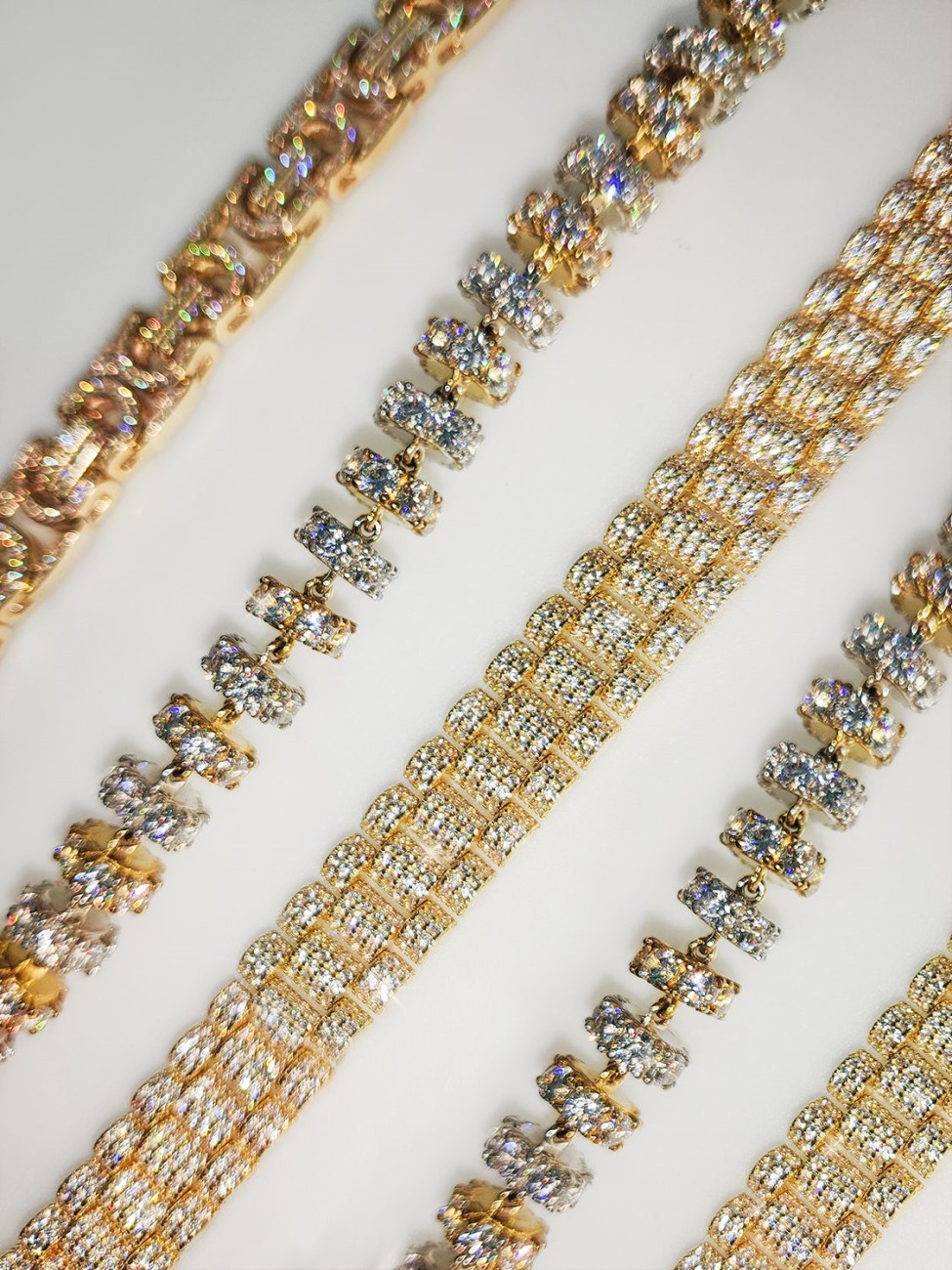
The Miami Cuban link chain became the foundation piece. Not because it looked the flashiest — but because it was the most durable. A 5mm Miami Cuban link in 14k gold could take a beating and still weigh enough to hold its melt value.
By 1985, the standard was a 20-inch, 5-6mm Miami Cuban link in 14k yellow gold. Weight: around 25-35 grams. Cost then: roughly $400-600. Today, that same chain (premium for vintage cut) runs $1,200-1,800 from a reputable dealer like Miami Gold Buyers or Daniel’s Jewelers.
The mistake I see collectors make? They buy modern machine-cut Cuban links that look too perfect. The original hand-cut links had subtle variations — the edges weren’t razor-sharp, the clasp wasn’t perfectly flush. That irregularity is what makes vintage chains feel authentic.
Why Rope Chains Dominated the Mid-80s
By 1986, rope chains overtook Cuban links in popularity. Why? Two reasons.
First, rope chains caught light differently. They sparkled more than a flat Cuban link, which mattered under club lighting. Second, rope chains were lighter for the same visual thickness — you could wear a 7mm rope that weighed 20 grams, while a 7mm Cuban link would weigh 40 grams. Cheaper to buy, same visual impact.
LL Cool J wore a thick rope chain in the “I’m Bad” video (1987). That single video sold thousands of rope chains in New York alone. Jacob the Jeweler started his career making these ropes, long before he became the go-to for iced-out watches.
The Pendant Era: When Hip Hop Jewellery Became Art
Here’s where the history splits. The late 80s and early 90s saw two parallel developments: the rise of custom pendants and the birth of the iced-out watch.
The pendant was a status marker that said more than a chain ever could. A gold chain said “I have money.” A custom pendant said “I have a story.”
Biggie’s Jesus piece. Tupac’s cross. Jay-Z’s Roc-A-Fella chain. Each of these pieces told you exactly who the wearer was without them saying a word.
The Jesus Piece — The Most Important Pendant in Hip Hop
The Jesus piece wasn’t invented for hip hop. Italian jewellers had been making them for decades. But Biggie Smalls made it iconic. His was a custom 18k yellow gold piece from Jacob the Jeweler, weighing around 100 grams, with diamond eyes and a diamond crown of thorns.
Here’s what most articles won’t tell you: the original Jesus pieces weren’t iced-out. They were plain gold with maybe diamond eyes. The fully iced-out version came later, around 1997-1998, when rappers started competing to see who could cover more surface area in diamonds.
If you’re buying a vintage-style Jesus piece today, look for one with minimal diamond coverage — just the eyes and maybe the crown. The Mister T Jesus Piece (yes, the A-Team guy sold them) from 1989 is a perfect reference point: 14k gold, no diamonds, around $800 at the time. Today, that same piece in good condition sells for $3,000-4,000.
| Era | Dominant Style | Typical Weight | Diamond Coverage | Example Piece |
|---|---|---|---|---|
| 1980-1985 | Gold rope or Cuban chain, no pendant | 20-35g | 0% | Run-DMC rope chain |
| 1986-1992 | Thick rope chain + gold pendant | 40-60g chain, 20-40g pendant | 0-10% (eyes only) | LL Cool J rope + medallion |
| 1993-1997 | Cuban link + Jesus piece or cross | 60-100g total | 10-30% | Biggie’s Jesus piece |
| 1998-2005 | Iced-out everything | 100-200g total | 50-100% | Jay-Z’s Roc-A-Fella chain |
| 2006-present | Mixed: vintage revival + extreme custom | 50-300g | Varies wildly | Ben Baller custom pieces |
The Iced-Out Watch: How Hip Hop Changed the Watch Industry
This is the section where I’m going to make some people angry. But here’s the truth: hip hop single-handedly saved the high-end watch industry in the late 1990s.
In 1995, the Swiss watch industry was in trouble. Quartz watches had decimated mechanical watch sales. Rolex was struggling. Patek Philippe was a niche brand for old men. Then hip hop discovered watches.
Jacob the Jeweller started putting diamonds on Rolex Day-Dates around 1996. The “President” watch — already a status symbol — became the canvas for full diamond bezels, diamond dials, and eventually diamond cases. The Rolex Day-Date 118238 (yellow gold, 36mm) was the base model. Cost then: around $15,000 retail. Jacob’s iced-out version: $40,000-60,000.
Hip hop didn’t just accessorize with watches. It created a new category: the watch as jewellery first, timepiece second.
The Audemars Piguet Royal Oak — The Ultimate Hip Hop Watch
If there’s one watch that defines modern hip hop jewellery, it’s the Audemars Piguet Royal Oak. Specifically, the 39mm Royal Oak Jumbo Ref. 15202 in steel. Retail today: around $35,000. Market price: $60,000-80,000.
Why did hip hop adopt the Royal Oak? Three reasons. First, the octagonal bezel and integrated bracelet made it instantly recognizable — you could spot it across the club. Second, the exposed screws on the bezel gave it a mechanical, industrial look that matched hip hop’s street aesthetic. Third, it was a flex that only people who knew watches would recognize — a subtle brag for insiders.
The Patek Philippe Nautilus 5711 played the same role in the 2010s. Retail was $34,000. By 2026, it traded for $130,000. Hip hop collectors drove that market. Drake, Jay-Z, and Future all wore Nautiluses. The Tiffany blue dial 5711 (2026) — retail $52,000 — sold at auction for $6.5 million. That’s hip hop influence.
My advice? Don’t buy an iced-out watch as an investment. Buy a clean, unmodified steel sports watch from Rolex, AP, or Patek. The aftermarket diamond work destroys resale value. A 1999 Rolex Day-Date in original condition: $25,000. The same watch with Jacob-style diamond bezel: maybe $18,000, and only to the right buyer.
Common Buyer Mistakes (And How to Avoid Them)
I’ve made almost every mistake you can make buying hip hop jewellery. Here are the ones I see people repeat most often.
Mistake 1: Buying hollow chains. A hollow gold chain looks the same as a solid one in the display case. But wear it for six months and the links start flattening. The clasp fails. The chain kinks permanently. Solid chains cost more upfront — a 14k 5mm Miami Cuban link in solid costs about $2,500 for a 22-inch at current gold prices. Hollow is $800-1,200. Buy solid. Every time.
Mistake 2: Overpaying for “iced-out” pieces from mall jewellers. The chains and pendants at Kay Jewelers or Zales use low-quality diamonds — I clarity, J-K color, poor cut. They charge $3,000 for a piece that has $600 in diamond value. Go to a specialist. Icebox in Atlanta or Ben Baller’s IF & Co. in LA are reliable. You’ll pay more, but the diamonds are GIA certified and the settings don’t fall apart.
Mistake 3: Ignoring the clasp. The clasp is the most stressed part of any chain. A lobster clasp with a 4mm opening is standard for chains up to 5mm. For heavier chains (6mm+), you need a box clasp with a safety latch. I’ve seen a $5,000 chain fall off someone’s neck because the clasp was undersized. Check the clasp before you buy. If it feels light or flimsy, walk away.
Mistake 4: Buying “vintage” pieces without provenance. There’s a booming market for fake vintage hip hop jewellery. People are selling machine-made Chinese copies of Biggie’s Jesus piece as “original vintage.” Real vintage pieces from the 1980s and 1990s have hand-finished details — the back of the pendant won’t be perfectly flat, the edges will have slight tool marks. Ask for original purchase receipts, old photos of the piece being worn, or documentation from the original jeweller. If the seller can’t provide any of these, assume it’s a reproduction.
When NOT to buy hip hop jewellery. If you’re buying for investment, don’t. Hip hop jewellery has terrible liquidity. A $10,000 chain will get you $3,000-4,000 at a pawn shop. If you’re buying for daily wear, skip anything with pave diamonds — the small stones fall out within a year of regular use. And if you’re buying for a costume or a single event, rent. Rent the Runway and local high-end jewellery rental shops in major cities offer iced-out pieces for $200-500 per week. Don’t buy something you’ll wear once.
Where Hip Hop Jewellery Is Going Next
The market has shifted hard toward vintage and understated pieces. The fully iced-out 200-gram chain is out. The clean gold chain with a meaningful pendant is back.
Tyler, The Creator wears a simple gold rope chain with a gold mushroom pendant. A$AP Rocky wears vintage Cartier and a thin gold chain. Kendrick Lamar wears a plain gold chain with a small cross. The trend is personal, not loud.
But the real innovation is happening in materials. Ben Baller has been experimenting with titanium and meteorite inlays. Jacob & Co. released the Astronomia watch — $500,000-1,000,000 — with a rotating celestial display that has nothing to do with telling time. It’s pure mechanical art. That’s where hip hop jewellery is heading: away from just covering things in diamonds, toward genuine craftsmanship and unique materials.
The Miami Cuban link remains the foundation. But now it’s being made in platinum, in two-tone, in rose gold. The iced-out pendant is being replaced by the custom engraving — names, dates, coordinates. The watch is becoming a canvas for independent watchmakers, not just a Rolex with aftermarket diamonds.
If I were buying one piece today to represent the history and the future of hip hop jewellery, it would be a solid 14k yellow gold Miami Cuban link chain, 5mm, 22 inches, from a reputable Miami jeweller like Miami Gold Buyers or Gold Royalty. Cost: around $2,800 at current gold prices. No diamonds. No pendant. Just the chain that started it all, made the way it was made in 1985. That chain will never go out of style, will always hold its melt value, and connects you directly to the culture that created it.
That gold rope chain Kurtis Blow rapped about in 1980? It’s still the right move today. The names change. The chain stays.