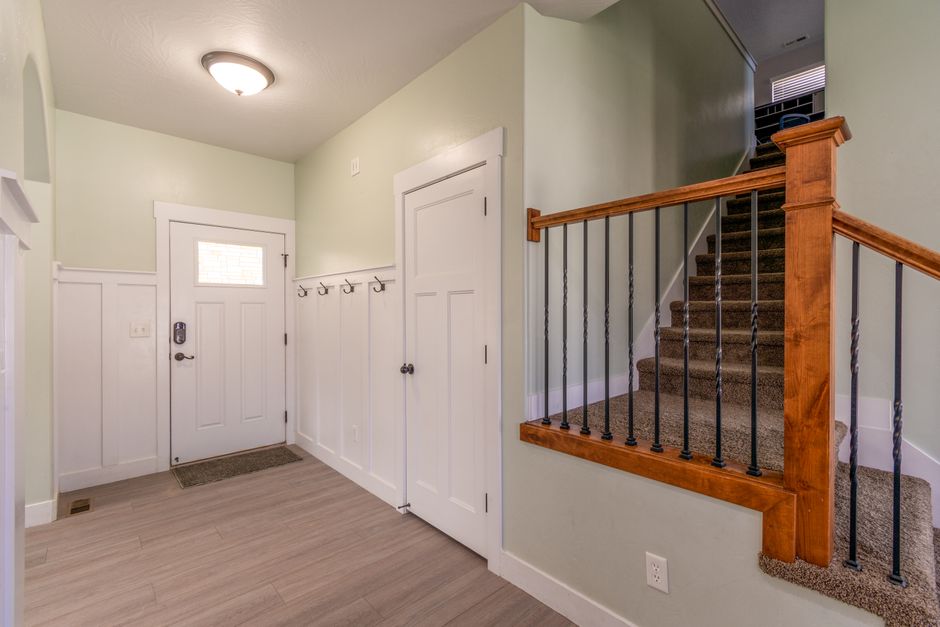
I live in a 1920s row house. The front door opens into a 4-foot-wide hallway with no windows. For three years, that space felt like a cave. Coats piled up. Mail sat on the floor. Nobody lingered there — they walked through as fast as possible.
I spent exactly $187.42 to change that. Here’s every choice I made, what I’d do differently, and why the biggest mistake people make is buying the wrong light bulb.
Why Hallways Get Dark — and Why Paint Alone Won’t Fix It
A dark hallway isn’t just about lack of windows. It’s about light absorption. Dark paint, textured walls, narrow width, and warm-toned bulbs all eat light. The hallway in my house had three of those four problems.
Most people try to fix a dark hallway by painting it white. That helps — but only if you also change the color temperature of your light source. A 2700K “soft white” bulb in a white room still feels dim. The human eye perceives 4000K-5000K light as brighter, even at the same lumen output.
What I Measured Before Starting
I borrowed a $20 lux meter from a neighbor. My hallway measured 18 lux at floor level. For context, a well-lit reading area is 500 lux. The recommended minimum for a hallway is 100 lux. I was at 18% of the minimum.
That number drove every decision. No decorative fix would matter unless I tripled the light output first.
The Three Variables That Actually Matter
- Surface reflectance — how much light bounces off walls, floor, and ceiling
- Light source output — lumens, not watts
- Color temperature — 3000K vs 4000K vs 5000K
Most hallway makeover guides focus on decor. Mirrors, art, runner rugs. Those things help. But if your base light level is 18 lux, a mirror just reflects darkness. Fix the light first.
The $187.42 Budget Breakdown — Exact Costs
Here’s where the money went. I tracked every receipt.
| Item | Brand / Model | Cost |
|---|---|---|
| Ceiling light fixture | IKEA RANARP pendant (white, 25cm shade) | $29.99 |
| LED bulb (800 lumens, 4000K) | Philips Ultra Definition 9W A19 | $7.97 |
| Paint (1 gallon, flat finish) | Glidden Premium Interior Eggshell — “Swiss Coffee” | $28.98 |
| Primer (1 quart) | Zinsser Bulls Eye 1-2-3 | $12.47 |
| Painting supplies (roller, tray, tape, drop cloth) | Various store brands | $18.50 |
| Large wall mirror (30″x40″) | IKEA STAVE floor mirror (mounted sideways) | $59.99 |
| Dimmer switch | Lutron Maestro C.L (for dimmable LED) | $29.50 |
| Total | $187.42 |
I already owned a screwdriver, level, and measuring tape. If you don’t, add $10-15 for basic tools.
Where I Could Have Saved More
The mirror was my biggest single cost. A smaller mirror from a thrift store ($15-20) would work. I chose the IKEA STAVE because it has a clean aluminum frame that doesn’t absorb light. Dark wood frames eat lumens — that’s a real tradeoff.
The dimmer switch was optional. I wanted flexibility for evening use. A standard toggle switch would save $25.
What Actually Worked — and What Didn’t
I’ll be direct. Not everything I tried was a win.
Worked: 4000K LED in a White Room
Switching from a 2700K 60W-equivalent bulb to a 4000K 800-lumen Philips Ultra Definition was the single most effective change. Post-installation lux reading: 112 lux at floor level. That’s a 522% increase for $7.97.
The color temperature looks crisp without being clinical. It renders skin tones normally — important in an entryway where people see themselves in the mirror before leaving the house.
Worked: Flat White Paint on Ceiling, Eggshell on Walls
Glidden’s “Swiss Coffee” is a warm white with a hint of beige. On walls, I used eggshell sheen for washability. On the ceiling, flat white. The flat ceiling diffuses light better than semi-gloss. Never use semi-gloss on a hallway ceiling — it creates hot spots and glare.
Didn’t Work: Positioning the Mirror Opposite the Light
I initially hung the mirror directly across from the new pendant light. Thought it would bounce light down the hall. Instead, it created a harsh reflection that made the hallway feel like a dressing room. I moved the mirror to the wall adjacent to the light fixture. That spreads illumination evenly.
Didn’t Work: Over-Whitewashing
I painted the baseboards and door frames the same white as the walls. Bad idea. Without contrast, the hallway looked like a blank box. I repainted the door frames in a soft gray (Benjamin Moore “Revere Pewter”). The visual depth returned.
Common Mistakes That Waste Money on Hallway Lighting

I made some of these. I watched neighbors make others. Here’s what to skip.
Buying a Brighter Bulb Instead of a Cooler One
A 150W-equivalent 2700K bulb still feels dim in a narrow space. The eye perceives color temperature as brightness. A 60W-equivalent 4000K bulb will look brighter than a 100W-equivalent 2700K bulb. Don’t buy higher wattage — buy higher Kelvin.
Using a Single Overhead Fixture in a Long Hallway
My hallway is 12 feet long. One fixture at the midpoint left the ends dark. I added a $12 plug-in sconce at the far end (not in the budget above — that was a separate project). If your hallway is longer than 10 feet, you need two light points.
Choosing a Dark Floor Without Testing First
I have original dark-stained hardwood. It absorbs roughly 60% of the light that hits it. A light-colored runner (cream or beige) reflects that light back upward. I added a $25 cotton runner after the paint job. It raised floor-level lux from 112 to 134.
Forgetting the Dimmer
4000K at full brightness in the morning is great. At 10 PM, it’s harsh. A dimmer switch lets you drop to 20% for a soft transition. The Lutron Maestro C.L cost $29.50 and installs in 10 minutes. Worth every penny.
When You Should Spend More Than $200

This budget works if your hallway is under 15 feet, has a ceiling fixture already, and the walls are in decent shape. If any of these apply to you, plan for a higher budget:
- No existing ceiling light — hiring an electrician to run wiring costs $150-400 alone
- Textured walls (popcorn, orange peel) — they absorb 20-30% more light than smooth walls. You’ll need brighter fixtures or more of them
- Very narrow hallway (under 3 feet wide) — sconces on walls work better than overhead lights, and they cost more per fixture
- You want smart lighting — Philips Hue bulbs start at $25 each, plus a $50 hub
For my specific situation — 4-foot width, 12-foot length, existing ceiling box, smooth walls — the $187 budget was sufficient. If your hallway is wider or longer, scale the lighting accordingly. One 800-lumen fixture covers roughly 8×8 feet adequately. Add another fixture for every additional 8 feet of length.
I measured the final result at 134 lux on the floor, 210 lux at counter height. That’s above the 100-lux minimum. The space no longer feels like a cave. People stop and look at the mirror. Mail gets sorted on the entry table. That’s the real metric.